
Oslo, or music in the broadest sense
Updated 24 September 2026
The Paris Conservatoire is one of the eight institutions that make up the European alliance IN.TUNE, dedicated to higher education in music and the arts. Each season, we devote an article to one of the member schools, to better understand these partners and what their way of working can teach us about our own. After Belgrade last year, this second stop takes us to Oslo, to the Norwegian Academy of Music, which coordinates the alliance’s long-term strategy. There, we discover degree programmes in which music therapy holds the same status as performance, the legacy of a decision made in 1973 to educate “broadly” rather than produce only a handful of virtuosos, and a way of thinking about education, quality, and the social role of music: all reflections shared by conservatoires across Europe.
We arrive at the Norwegian Academy of Music (Norges musikkhøgskole, or NMH) through Majorstua, a neighbourhood ten minutes by tram from central Oslo. Situated between the police academy and, on the other side, the school of theology, the building is marked by a certain sobriety: a tall volume of reddish-brown brick, almost tower-like, bearing the school’s name across the façade, Norges musikkhøgskole. On the doorstep, a poster announces the day’s programme before you step through the glass doors. Inside, the first striking thing is the silence: not a sound escapes the closed practice-room doors, except, somewhere upstairs, a violin that we spend two days trying unsuccessfully to locate. A cafeteria on the ground floor (and, let’s be honest, much better than ours in Paris), students gathered around tables in groups of four or five, and the particular light of a May month when night never quite falls.
We spend two days there, between meetings and conversations with administrators, faculty, and students. The school has around 850 students, trained in music in the broadest possible sense of the word. But what sets it apart is not its walls: it is what is taught there, and the way the institution conceives itself.
The choice made in 1973
The institution’s origins go back further than they first appear. In 1883, a small advertisement appeared in an Oslo newspaper: a school was being founded to train organists because the country lacked church musicians. This became the Oslo Conservatory of music, which was run by three generations of the Lindeman family, who established it. The main auditorium still bears their name today.
The school became a state academy in 1973, after a closely contested parliamentary debate: fifty-seven votes to fifty-two, with Bergen challenging Oslo for the honour of hosting the new institution. Astrid Kvalbein, rector since 2021, describes what she sees as the defining choice of that period. “There was a debate: should we create an elite programme for a select few, or something broader? They chose something broader.” Not only exceptional soloists, but also teachers, accompanists, church musicians, and researchers. “This broad approach aimed to educate the musicians society needs.”
Today, NMH trains classical performers, jazz musicians, folk-music practitioners, music therapists, and even piano technicians on an equal footing, within complete degree programmes at the highest level. Music therapy is not an elective seminar: it is a three-year bachelor's degree that includes a minimum of two years in fields such as music, pedagogy, health, or social sciences, combined with the one-year NMH programme in music and health.
The later arrival of jazz, traditional music, and music therapy was far from self-evident. How do you teach music history when popular music must be included? How do you transmit knowledge that was previously passed down orally? Astrid Kvalbein does not hide the fact that these questions are still discussed, and that is precisely what she values. “This constant questioning keeps us alive.”
The academy likes to describe itself as “a transmitter of heritage, not a museum guard,” a phrase the rector values, provided it is not misunderstood: rejecting the museum does not mean despising heritage, but refusing to place music behind glass. “You cannot assume that something written in the 1850s is automatically still relevant today: the world has changed.” From this comes an explicit rejection of conservatism, including, she specifies, on questions of gender. A conservatoire, yes; conservative, no.
“Quality emerges through relationships”
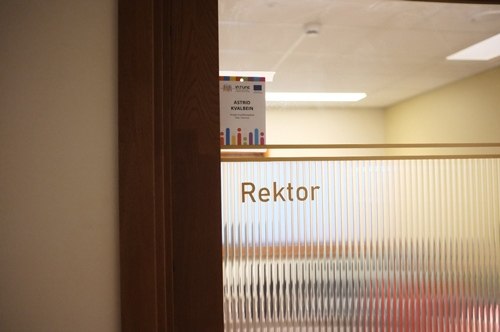
Astrid Kvalbein welcomes us into her third-floor office, a simple room displaying the IN.TUNE logo. Her smile is immediate and instantly puts you at ease: she speaks calmly, with a humour one senses more than she openly displays. She was a soprano, a musicologist, and a music critic before being elected rector in 2021 and reappointed until 2029. This plurality, she says, is not a biographical detail: it is what makes the role sustainable for her. The performer knows what it means to practise an instrument. The researcher can speak as an equal with other university heads. The critic has experienced freelance life, the reality for which NMH prepares most of its students.
In her opening speech for the 2024 academic year, she offered a definition of quality: “I like to think of quality as something that emerges through relationships.” She elaborates: “Quality can be understood not as relative, but as relational.” One form of musical quality may matter because it works between a music therapist and a young person facing psychiatric difficulties; another because it unfolds between a soloist and an orchestra. Neither ranks above the other.
She often thinks about graduates: “Many find work within a fragile infrastructure: a small town with a tiny wind band and barely a music school, a church music programme with almost no budget.” Hence the need, she says, for “a stronger awareness of why music matters, for people, in every society.”
And this conviction does not remain abstract rhetoric. In November 2024, NMH publicly supported the Østfold Academy of Performing Arts, threatened with closure; its vice-rector, Morten Qvenild, called the decision “tragic” and denounced a new funding system particularly harsh on arts education. More recently, the institution mobilised against cuts affecting a municipal music school in Oslo: “Children need access to music if they are ever to come here one day.” Østfold closed nonetheless. Astrid Kvalbein does not try to embellish reality: “It did not change the decision. But at least we took a stand. And that matters.” When she speaks to the ministry, she adds, “I feel I speak on behalf of all conservatoires.” NMH itself underwent restructuring and financial cuts in 2023, which she calls “a year of struggle.”
The class you cannot skip
Lucie Lou Camps has the easy laugh and direct gaze of someone who has already experienced several institutions. Before NMH: the CRR de Paris, the Versailles Baroque Music Centre Choir School, an academy in Sweden. She is now in her third year of a bachelor’s degree in choral conducting. She describes NMH as “a very small school, but with lots of opportunities, because everyone knows everyone”: sixty students per year group, and a sense of creative stimulation unlike anything she experienced before.
And yet her presence there was not the result of some grand plan: “I simply wasn’t accepted in Stockholm.” What kept her in Oslo came down to a meeting. During her entrance exam, she encountered Grete Pedersen, whom she considers one of the world’s greatest choral conductors. Pedersen stopped, asked her name, what kind of music she liked; they talked for fifteen minutes. “Just a human being in front of me. No teacher-student barrier, no ‘I know better than you.’” And, about the people who auditioned her, she mentions almost in passing: “Five women here, and not a single question about my gender, where I came from, or why.”
What strikes her most is the genuine broadening of aesthetics and methods. On Wednesdays, a module in Norwegian traditional music history. On Fridays, ear training is not really ear training but a derivative of the Dalcroze method, rooted in the body. “I’ve never done note-reading here, never. So now I can’t read alto clef anymore. Totally useless in life.” She laughs. “But it’s another way of approaching ear training, more practical.”
Her relationship to music has changed. “There is always a link to where I come from. The music of Occitania from my father’s side, the music of Martinique from the other side. Of course, there will be Brahms and Bach, but there is this idea of how you connect the two. I never experienced that in France, nor in Sweden.” She gives an example she heard in Oslo: a very classical mass composed by a student from “some remote village,” with a Bach motet inserted in the middle, connected by folk songs her grandmother used to sing, which she had rewritten herself. “There’s no ‘you have to do this.’ It’s ‘what do you want to do?’”
And then there is what she talks about when asked how she is doing. “In first year, we have a compulsory course called Musician’s Health. Lots of people tried to skip it: you can’t, otherwise you fail the year.” They talk about sleep, diet, mental health, and “drug use before exams. The dialogue is just open.” She arrived with a habit of taking beta blockers and CBD before performances; she lost it there. “I went from taking them before every exam to none at all. Because everyone is so supportive. The juries are so supportive. It’s calm, it’s collaborative.” Here, an exam feels nothing like a Champions League final where you either win or disappear. Care is not only in words: when her back gave out last year, she got an appointment with the school physiotherapist the next day, eight free sessions, where they “spent a lot of time talking about how I was doing.”
Daily life follows the same logic: the number of times her conducting teacher tells her to go home at six rather than stay until eight. “For them, school is a job. So it’s nine to six, no more. And it makes for happier students.” A pause. “Maybe less good, but much happier.”
She says it casually. But the sentence lingers. It names the tension institutional narratives tend to avoid: in a school of excellence, a student from abroad calmly observes, almost as an obvious fact, that people there might perhaps be less outstanding. And, in the same breath, so much happier. It is up to each person to decide whether that is a compromise or a victory.
Victoria at night
The Majorstua building is silent during the day. In the evening, elsewhere in the city, the music finally lets itself be heard. We follow it to Victoria, Oslo’s national jazz venue on Karl Johans gate: a public hall, not a school auditorium, where students from the jazz department perform their end-of-year recital.
One might have expected a display of orthodoxy; instead, the opposite unfolds. The stage belongs to the double bassists, and the programme feels like a carte blanche: music leaning toward folklore, traditional colours infused into jazz, as though Lucie’s Wednesday module had left the classroom and stepped onto the stage. Here, one understands what “training on an equal footing” truly means: jazz and tradition are not secondary electives — they are central, they fill a concert hall. This is what these students embody in Astrid Kvalbein’s eyes: flexible musicians who compose, improvise, and perform “in a way that perhaps recalls what musicians did in Beethoven’s time, before all these practices became separated.” That evening, at Victoria, no such separation exists.
That evening, in Victoria, there was none of the formality of an examination. The atmosphere is so relaxed that it takes a moment to grasp what the scene is saying: solemnity is not, here, a condition for quality. Another norm prevails, the same one as the teacher who sends Lucie home at six in the evening: it is possible to aim high without becoming rigid. The concert resumes; in the audience, no one looks at their watch.
“I felt I was losing my love of music”
Karette Stensæth welcomes us into one of the small, enclosed pods scattered through the open-plan offices along a corridor, on the same floor as CREMAH, the Centre for Research in Music and Health that she directs. Dark burgundy felt, pale wood, Scandinavian design through and through: it almost feels like the inside of a camper van, ready to head off toward the fjords. She speaks with a calm voice, combining the precision of a researcher with the warmth of a practitioner. Trained in musicology and laying classical guitar, she discovered music therapy almost by chance, and through exhaustion. A few semesters into her studies, she had begun to doubt: not music itself, but the environment surrounding it. “I found it extremely competitive, and I didn’t like it. I felt I was losing my love of music.” One lunchtime in the cafeteria, her eye caught a notice pinned to the wall: “Do you enjoy working with music and with people? Have you ever considered music therapy?” She applied that very day and has never regretted her decision. Twenty years of work with children living with disabilities followed, then a doctorate, and eventually the Centre.
Training as a music therapist takes five years, and it happens here, within a music academy, not a faculty of medicine. A detail that changes everything, because behind this institutional placement lies a particular understanding of health. “Health is also what gives you life, what brings joy, the way you are able to shape your own life.” If health is not simply the absence of illness but what makes a life worth living, then music ceases to be merely an added luxury of the soul. Norwegian hospitals, schools and cultural settings now more often turn to CREMAH to find music therapist to work with them and also perform research, such as in dementia care, in mental health and addiction, in hospitals with children with cancer and premature babies, and in work within schizophrenia, for which music therapy here holds the highest level of clinical recommendation. “At first, and especially before we had good research, music therapy was often not taken seriously. Today, it is a well-established practice and research field, and our field of work is extremely broad.”
What music therapy changes within the institution
Karette insists on what remains invisible: what this presence changes for the rest of the conservatoire. The music therapy teachers and students do not teach pianists or violinists, but their presence “creates a greater awareness across the field.” First and foremost, an awareness of the role of the other and who the audience is. She describes one of the projects she is proud of: instrumentalists performing in prisons, accompanied by a music therapist who helps them reflect on the vulnerability of incarcerated people. “They learn to care both for themselves and for the people in front of them. If I had to name one thing about the influence of music therapy on all students, it would be that they develop a greater attentiveness to the person in front of them. Who are they? What are they feeling? They are not just playing for themselves.” In an environment constantly asking, “How good am I?”, the question becomes: “What good can music do?”
One word nonetheless remains difficult to utter in a school of excellence: competition. Like all major academies, NMH has students who struggle: performance anxiety, feelings of inadequacy, physical pain. Karette does not pretend to solve this with a book under her arm: “There is a long history behind this strict culture of performance.” But she holds one conviction as a practitioner: “In therapy, we say that once the problem is named, the therapy is already halfway done.” Naming it, acknowledging it; the means come afterwards, and they can only be institutional. “Leadership has to want change. There has to be a strategy for it.”
She does not let us leave without a recommendation: “I think you should have a music therapy programme in your conservatoire.” She says it as one points out an overlooked obviousness, opening a door: an exchange, a small introductory course, IN.TUNE as a framework. And she has noticed a trend that surprised her: performers, singers, and teachers who also want music therapy training. The model of a position split between artist and music therapist is becoming more widespread. “They are starting to see it as something intelligent to have alongside performance.” When asked, finally, what the most beautiful thing she has witnessed in forty years might be, she returns to children, those who found a way to communicate where no one expected it anymore. “Perhaps no more than ten. But they are stories I will carry in my heart forever.”
Europe, through people
Launched in 2024, the IN.TUNE alliance brings together eight institutions, including NMH and the Paris Conservatoire. The Norwegian academy considers the alliance’s long-term strategy an extension of its own institutional direction: for its fiftieth anniversary in 2023, it set itself a horizon for 2035 under the tagline Music Moves.
What holds the alliance together, says the rector, has less to do with structures than with people. She has worked for years with Émilie Delorme, director of the Paris Conservatoire, with great pleasure. “What strikes me most about IN.TUNE is how human and personal it is. Putting the right people in the right place ultimately matters more than cultural differences.”
Yet there is also a deeper concern she does not conceal. Rumours are circulating about the possible removal of the arts from the Horizon Europe programme; political priorities are shifting toward health, technology, and defence. Norway, outside the European Union, participates from an ambivalent position. The greatest risk facing European conservatoires in the coming decade? “It’s a rather boring answer, but I would say finances.” Yet money is not her only concern. She observes the erosion of a shared cultural experience: “When I was young, there was one major national television channel, and everyone watched a bit of culture, a bit of everything. Today, people live in separate media worlds.” An alliance like IN.TUNE attempts to recreate a little of that shared space on a continental scale.
At half past eleven, early, in the Norwegian way, the entire administrative team gathers in a room, each carrying their bento, those stacked open sandwiches that pass for lunch here. People eat calmly, without screens or paperwork. Then comes the quiz: today, it is the head of finance asking the questions. The very person whose job embodies the anxiety the rector had summed up in a single word is, at noon, leading the collective game. What holds an institution together, she had said, is not its structures but its relationships. At half past eleven, bento in hand, one sees the proof of it.
Shifting the perspective slightly
At NMH, attentiveness to others is not a tagline; it is a habit. Astrid Kvalbein often cites the Demenskoret, a choir made up of people living with dementia that became a hit television series in Norway, and whose possible integration into the healthcare system she discussed with the mayor of Oslo. “Projects like this show the power of music by focusing not on the level of the performers, but on the good it does for others.”
A more modest tradition captures the same philosophy. Each year, a chamber music week is carried out, and now more often built around a theme: climate change one year, works by women composers the year before, contemporary music this year. One unexpected effect of the “women composers” year: a trombone professor, drawn into the spirit of the theme, had to search for and purchase scores by a composer he did not previously know. Those scores entered the programme and library collection. “Hopefully, this is an example of how we created a small but meaningful change, this time within the brass department.”
What music sets in motion
At the end of the stay, we cross the cafeteria one last time. Lucie had told us about the choir she conducts on Tuesdays; Karette wanted to take us, if we returned, to see the dementia choir in rehearsal. Astrid Kvalbein, meanwhile, insisted on adding one sentence that did not need to be said: “We love Paris.”
Seen from Paris, the Norwegian institution does not offer a model to imitate: the ecosystems are simply too different. What it offers instead is another way of answering a question every IN.TUNE institution is asking itself: what is a conservatoire for in the twenty-first century, and what does it owe the society that funds it?
Astrid Kvalbein likes the multiple meanings contained in the institution’s tagline, Music Moves: in English, “to be moved” means to be emotionally touched, to be displaced, to be transformed. “Everything is in motion, so we too must move. Music is alive. It moves us; it can touch us deeply.” That is perhaps why we travel all the way to Oslo, and return with, lingering in the ear, the sound of a violin we never managed to locate, and which, ever since, has never stopped playing.
Alexandre Pansard-Ricordeau, Head of communications at Paris Conservatoire.
This article originally appeared in the Paris Conservatoire’s 2026–2027 season brochure. Discover it now.